We specialise in examining, identifying and providing reports on prehistoric to medieval and early modern glass artefacts and evidence of glassworking.
Glass artefacts are often found during excavation of archaeological sites while they have also come to light as stray finds. Glass is probably the most tangible of all archaeological materials. Preserving colour, decoration and chemical indicators, it is an important link to past culture, trade-links, chronology and origin.
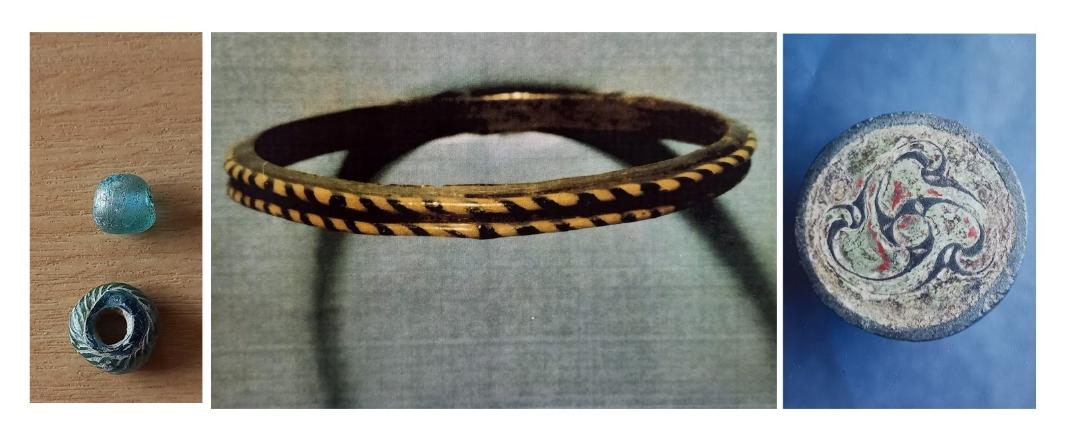
Glass is found, mainly in the form of beads andbangles on prehistoric sites, often in burial contexts. It first appeared in Ireland during the Bronze Age. However it was during the Iron Age that glass jewelry, mostly beads, became widely used, probably because of the growth of glass industries in Britain and the Continent through trade with the Hellenistic and Roman world.
Glass artefacts were not manufactured in prehistoric Ireland. The evidence is that they were traded and all types can be paralleled with types from Britain, the Continent and the east Mediterranean. However, glassworking became widespread in Ireland during the early medieval period.
Glass beads, bangles, decorated glass studs, glass vessel fragments and millefiori are typical finds on habitation sites in the early medieval period in Ireland. Most bead-types appear to have been manufactured by Irish glassworkers during this time but beads were also traded from the east Mediterranean along with Anglo-Saxon and Viking types.
Glassworking evidence, including coloured glass rods, often cabled or fused, with clay moulds, crucibles and kiln waste, is also found in the medieval period, typically in contexts dating from the mid-first millennium AD to the early 2nd millennium. Enameled metalwork, where coloured opaque glass, fused to a metal base, often decorated with millefiori, was produced by Irish craftworkers.
Many types, including millefiori glass, glass rods and raw glass originated in the east Mediterranean and were exported to Britain and Ireland. Extensive evidence of early medieval glassworking is found on Irish sites, including ringfort and crannog sites and monastic/ecclesiastical settlements.
Glass is also a feature of the early modern and modern periods. Trade beads made from the 15th/16th century onwards, mainly from the Netherlands or Venice, are a frequent find . From the 16th/17th centuries, glass vessels with Continental parallels are found in Ireland. Ornamental glass artifacts, often miniatures, inspired by Continental fashion or imported from the Continent, have come to light from 17th/18th century contexts.